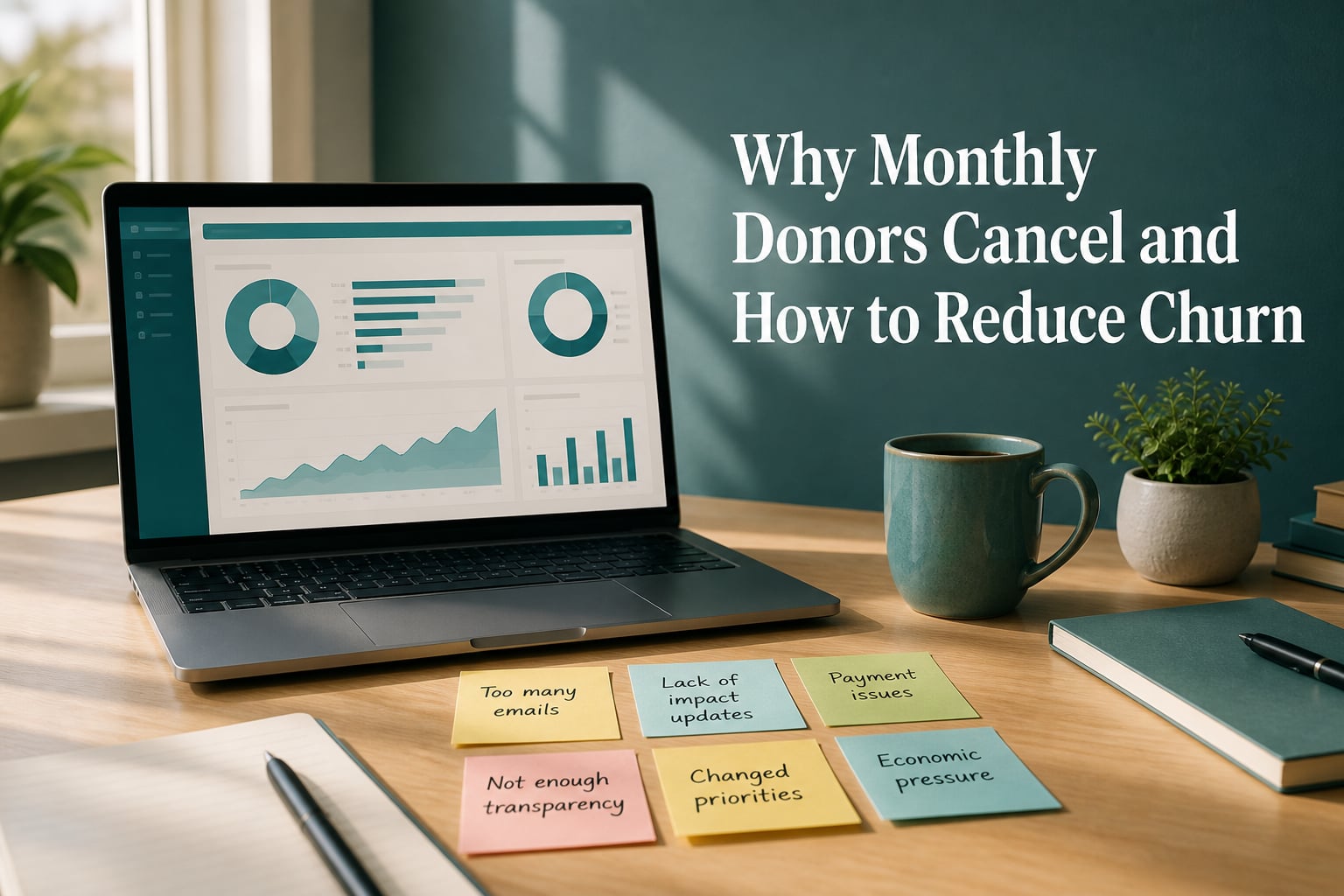
If your nonprofit has ever wondered where the monthly donors went, you are not alone. The Fundraising Effectiveness Project reports a first-year donor retention rate of just 31.9% for Q3 2025, and the sector-wide average sits at 54.73% according to the Virtuous 2026 Nonprofit Benchmark Report.
That gap between acquisition and retention is where most organizations bleed revenue. In this guide, I will walk you through exactly why monthly donors cancel, the difference between voluntary and involuntary churn, and the specific tactics our team has seen lift monthly retention above 70% within twelve months.
Table of Contents
- 1What Is Donor Churn and Why Monthly Donors Cancel
- 2Current Donor Retention Rate Benchmarks for 2026
- 37 Main Reasons Donors Cancel Their Recurring Gifts
- 41. Financial Hardship or Shift in Budget
- 52. Loss of Connection to the Mission
- 63. Donor Fatigue From Over-Communication
- 74. Lack of Acknowledgment or Thank-You
- 85. Disagreement With Organizational Decisions
- 96. Donors Forget They Set Up the Gift
- 107. Better Option Appeared Elsewhere
- 11Involuntary Churn: The Silent Donor Killer You Can Prevent
- 12How to Prevent Involuntary Churn
- 13How to Calculate Donor Retention Rate the Right Way
- 14First-Time vs Repeat Donor Retention: Key Differences
- 1510 Proven Strategies to Reduce Donor Churn
- 161. Make the First 90 Days Count
- 172. Send Monthly Impact Updates, Not Just Receipts
- 183. Celebrate the Anniversary
- 194. Offer a Pause Option Instead of Cancellation
- 205. Segment Communications by Donor Behavior
- 216. Call Donors Who Reduce Their Gift
- 227. Implement Smart Payment Failure Recovery
- 238. Run a Quarterly Impact Report
- 249. Build a Community, Not Just a Donor List
- 2510. Survey Lapsed Donors Within 30 Days
- 26Common Mistakes Nonprofits Make That Drive Cancellation
- 27Treating Monthly Donors Like One-Time Donors
- 28Letting Payment Failures Linger
- 29Overasking in the First 90 Days
- 30Ignoring Donor Preferences
- 31Making Cancellation Easy but Updating Hard
- 32Frequently Asked Questions About Donor Churn
- 33How to stop monthly donations?
- 34Why are monthly donors important?
- 35What is donor churn?
- 36How to increase monthly donors?
- 37Final Thoughts: Building a Sustainable Monthly Giving Program
What Is Donor Churn and Why Monthly Donors Cancel
Donor churn is the percentage of donors who stop giving to your organization during a defined period, typically a fiscal year. You calculate it by dividing donors lost during that period by the donors you had at the start.
Churn falls into two distinct buckets. Voluntary churn happens when a donor actively decides to cancel, usually through your recurring gift management portal, an email, or a phone call. Involuntary churn happens when a donor intended to keep giving but a payment failed, an expired card slipped past your system, or the donor never received a failed-charge notification.
Most nonprofits focus on voluntary churn because it feels actionable. In our experience, involuntary churn often accounts for 20-40% of all recurring gift cancellations, and it is far easier to prevent than to reverse.
Monthly donors matter more than one-time donors because they provide predictable revenue, compound over time, and typically have a lifetime value 5x higher than single-gift supporters. A 5% lift in monthly retention can grow donor revenue 20-30% over three years without spending a single dollar more on acquisition.
Current Donor Retention Rate Benchmarks for 2026
The 2026 nonprofit landscape shows mixed signals. Here is what the latest reports reveal:
- Sector average retention rate: 54.73% (Virtuous 2026 Nonprofit Benchmark Report)
- First-year donor retention: 31.9% (Fundraising Effectiveness Project Q3 2025)
- Monthly donor retention at 12 months: 71% (M+R Benchmarks 2026)
- Monthly donor retention at 24 months: 54% (M+R Benchmarks 2026)
- Single-gift donors who never return: 68.5% (Keela 2026 sector analysis)
Monthly donor retention looks healthier than overall retention because people who commit to recurring giving self-select for stronger mission alignment. But the drop from 71% at year one to 54% at year two tells the real story: the second year is where most organizations lose ground.
Comparing your own retention metrics against these benchmarks is the first step. If your first-year retention is below 40% or your second-year retention is below 55%, you have meaningful room to improve.
7 Main Reasons Donors Cancel Their Recurring Gifts
Every cancellation falls into one of these seven categories. Understanding which ones hit your file most often is the key to fixing them.
1. Financial Hardship or Shift in Budget
Job loss, medical bills, or a tightened household budget are the most common reasons donors stop giving. When their situation changes, recurring gifts are often the first expenses they cut because cancelling feels less painful than ignoring a one-time request.
How to address it: Make it easy to pause a gift rather than cancel it. Offer to lower the monthly amount temporarily. Many donors will return at full price once their situation improves.
2. Loss of Connection to the Mission
Donors forget why they started giving. The initial emotional response that prompted their first gift fades within weeks if the organization never reinforces the story.
How to address it: Share specific, human impact stories monthly. Show the donor exactly what their recurring gift produced this month, not just a generic newsletter.
3. Donor Fatigue From Over-Communication
Ironically, nonprofits that ask for money too often drive cancellations faster than those who barely ask at all. When a donor receives multiple appeals, event invites, and fundraising emails each week, the relationship starts to feel transactional.
How to address it: Audit your monthly giving donor communications. Aim for a 70/30 ratio of impact stories to fundraising appeals. Segment your list so monthly donors receive stewardship first and appeals second.
4. Lack of Acknowledgment or Thank-You
A donor who never receives a personal thank-you within the first 48 hours of their first gift is statistically more likely to cancel within three months. The thank-you is the donor’s first proof that the organization values them.
How to address it: Automate an immediate personalized thank-you email. Follow up with a handwritten note within seven days. Call first-time monthly donors within thirty days to say thank you in person.
5. Disagreement With Organizational Decisions
Political positions, leadership changes, or programmatic shifts can trigger cancellations. Some donors will quietly disagree and simply stop their gift without telling you why.
How to address it: You cannot please every donor, but you can monitor your cancellation notes and survey lapsed donors to identify patterns. Transparent communication about major decisions reduces surprise-driven cancellations.
6. Donors Forget They Set Up the Gift
This is more common than most nonprofits realize. A 2025 study of lapsed donors showed that 14% had simply forgotten about their recurring commitment until they noticed the charge on their bank statement and decided it was no longer worth it.
How to address it: Send a quarterly impact summary that reminds donors their gift is active and producing results. Include the original signup date and total contribution to date.
7. Better Option Appeared Elsewhere
Another nonprofit made a stronger case, a personal cause became more urgent, or the donor’s values shifted. You cannot fully prevent this, but you can make your organization harder to leave by deepening the relationship.
How to address it: Build community beyond the transaction. Invite monthly donors to exclusive briefings, volunteer opportunities, or leadership calls. Donors with personal ties beyond their credit card are slower to leave.
Involuntary Churn: The Silent Donor Killer You Can Prevent
Involuntary churn is the under-discussed side of donor retention. It happens when a donor wanted to keep giving but the transaction failed for technical reasons, and no one from the organization intervened in time.
Common causes include expired credit cards, insufficient funds, address changes that interrupt billing, and bank security flags. Without automated retry logic and donor outreach, those failed payments become silent cancellations within 90 days.
Industry data suggests that 20-40% of recurring gift cancellations are involuntary. A donor who intended to keep giving $25 a month for ten years is now lost forever because a card expired and nobody noticed.
How to Prevent Involuntary Churn
First, set up automated card updater services through your payment processor. These services ping card networks for updated card numbers before each charge, recovering a significant portion of would-be failures.
Second, configure intelligent retry logic. Most processors allow you to retry failed payments on day 3, day 5, and day 7 with different decline reasons triggering different timing.
Third, send donor-facing notifications when a payment fails. A simple email that says, “Your monthly gift of $25 didn’t process. Update your card here to keep your impact going” recovers far more donors than a silent retry.
Fourth, alert your fundraising staff when a recurring gift fails three times. A personal phone call from a staff member recovers roughly half of donors who would otherwise be auto-cancelled by the system.
How to Calculate Donor Retention Rate the Right Way
The standard donor retention formula divides the number of donors who gave in both year one and year two by the number of donors who gave in year one.
Formula: (Donors retained from previous year / Donors from previous year) x 100
Example: You had 1,000 donors last year. Of those, 547 gave again this year. Your retention rate is (547 / 1,000) x 100 = 54.7%.
For monthly donors specifically, track retention at the 12-month and 24-month marks. A new monthly donor who gives their first gift on January 1, 2026, should still be giving on January 1, 2027, for your 12-month retention to count.
Cohort analysis takes this further. Group donors by the month they made their first recurring gift and track each cohort separately over time. This shows you whether your recent acquisition efforts are bringing in stickier donors or if your retention is sliding.
Aim to track at least three metrics monthly: overall retention rate, new donor retention rate, and monthly donor retention at 12 and 24 months. The Fundraising Effectiveness Project data is a useful benchmark for the first two, while M+R Benchmarks inform the third.
First-Time vs Repeat Donor Retention: Key Differences
First-time donors behave very differently from repeat donors. The Fundraising Effectiveness Project puts first-year retention at 31.9%, while retention climbs dramatically for second, third, and fourth-year donors.
Repeat donors who have given for three or more consecutive years often retain at rates above 70%. They have made an ongoing commitment, not a one-time decision, and they understand the organization’s rhythms.
This gap means your retention strategy needs to focus on the first-to-second gift transition. A first-time monthly donor who gives a second gift is statistically likely to keep giving for years.
Tactics that improve first-to-second gift conversion include immediate and personal acknowledgment, a phone call within 30 days, a second touchpoint at the 60-day mark showing impact, and an invitation to engage beyond financial support, like volunteering or attending an event.
Segmenting your monthly donors into first-year and multi-year cohorts allows you to invest your strongest stewardship in the group that needs it most. New monthly donors need reassurance and impact stories. Veteran monthly donors need recognition and insider access.
10 Proven Strategies to Reduce Donor Churn
These ten strategies are the ones our team has seen move the needle most consistently. Each addresses a specific reason donors cancel.
1. Make the First 90 Days Count
A new monthly donor’s risk of cancellation peaks in the first 90 days. Build an onboarding sequence that delivers impact stories, thank-you notes, and a personal welcome within that critical window.
2. Send Monthly Impact Updates, Not Just Receipts
Donors need to see what their gift produced. Replace generic receipts with a short monthly note showing the specific outcomes their support drove, such as meals served, students tutored, or animals rescued.
3. Celebrate the Anniversary
Send a personalized one-year anniversary email when a monthly donor hits their first full year. Recognize the milestone with a small gesture like a handwritten card, a video from a beneficiary, or a donor spotlight.
4. Offer a Pause Option Instead of Cancellation
Many donors who click “cancel” would happily pause for three to six months. Build a clear pause flow in your recurring gift management portal and watch how many donors return at full price later.
5. Segment Communications by Donor Behavior
Treat your monthly donors differently from one-time donors. Open rates, gift size, and engagement history should drive the content each donor receives. Generic blasts underperform tailored stewardship every time.
6. Call Donors Who Reduce Their Gift
When a donor lowers their monthly amount from $50 to $25, that is a signal. A short, grateful phone call within a week often recovers the original amount or uncovers a problem you can solve.
7. Implement Smart Payment Failure Recovery
Use card updater services, intelligent retry logic, and donor-facing failure notifications. Recovering a failed payment costs a fraction of acquiring a new donor.
8. Run a Quarterly Impact Report
Every 90 days, send monthly donors a comprehensive update on what the organization accomplished with their support. Include financial transparency, program metrics, and beneficiary stories.
9. Build a Community, Not Just a Donor List
Invite monthly donors to events, webinars, or behind-the-scenes tours. Donors with social ties to your organization cancel at far lower rates than those who only interact via email.
10. Survey Lapsed Donors Within 30 Days
When a recurring gift cancels, send a short survey asking why. The insights you collect will inform every other strategy on this list. Treat each cancellation as free consulting data.
Common Mistakes Nonprofits Make That Drive Cancellation
Even well-intentioned organizations drive cancellations through preventable mistakes. Here are the most common.
Treating Monthly Donors Like One-Time Donors
Recurring donors deserve a different communication cadence and content mix. When you send monthly donors the same appeals you send one-time givers, you wear out the relationship.
Letting Payment Failures Linger
If your team only notices failed payments during a quarterly audit, you are losing donors who could have been saved with a quick phone call.
Overasking in the First 90 Days
A new monthly donor is already giving every month. Asking them for an additional one-time gift, event tickets, or peer-to-peer fundraising within their first 90 days is the fastest way to make them feel taken for granted.
Ignoring Donor Preferences
If a donor has unsubscribed from email but you only communicate by email, you have already lost touch. Track channel preferences and use them.
Making Cancellation Easy but Updating Hard
Some organizations bury the “update card” button but feature “cancel gift” prominently. Flip that. Making it easy to update payment information is the single best defense against involuntary churn.
Frequently Asked Questions About Donor Churn
How to stop monthly donations?
To stop a monthly donation, log into the nonprofit’s online donation portal or recurring gift management page, locate your active recurring gift, and select the option to cancel or pause the gift. Most nonprofits also accept cancellation requests by phone or email, and some require written confirmation for gifts over a certain amount.
Why are monthly donors important?
Monthly donors are important because they provide predictable, recurring revenue that nonprofits can plan around, cost 5x less to retain than to acquire, and have a lifetime value roughly 5x higher than one-time donors. A 5% improvement in monthly donor retention can grow total revenue 20-30% over three years.
What is donor churn?
Donor churn is the percentage of donors who stop giving during a specific period, calculated by dividing the number of donors lost by the number of donors at the start of that period. For example, if you started the year with 1,000 donors and lost 250, your churn rate is 25% and your retention rate is 75%.
How to increase monthly donors?
To increase monthly donors, focus on converting one-time givers into recurring givers through dedicated landing pages, default monthly giving options at checkout, and follow-up campaigns that highlight the impact of sustained support. Effective tactics include a default monthly ask on every donation form, a recurring gift upgrade prompt after a successful one-time gift, and clear storytelling that explains why recurring support matters more than a single gift.
Final Thoughts: Building a Sustainable Monthly Giving Program
Reducing donor churn is not a single project. It is an ongoing practice of understanding why monthly donors cancel and removing those friction points one at a time.
Start by calculating your current retention rate using the formula above, then compare it to the 54.73% sector average and the 71% monthly donor benchmark. Audit your involuntary churn by reviewing failed payment data over the last six months.
Build a 90-day onboarding sequence for new monthly donors, configure card updater and retry logic to capture failed payments, and send a quarterly impact report that reminds donors their gift is active and working.
The nonprofits that win on retention treat donor churn as a daily discipline, not an annual report. Track your numbers monthly, survey lapsed donors within 30 days, and keep iterating. The result is a monthly giving program that funds your mission for years to come.