Anonymous donor acknowledgment is the process of thanking donors who choose to remain unnamed while respecting their privacy and meeting IRS requirements. For most 501(c)(3) nonprofits, this is one of the trickier parts of donor stewardship: you need to express genuine gratitude without exposing the person behind the gift. In this guide, I will walk you through how our team approaches private acknowledgment, the legal basics, and the small habits that make a big difference in donor relations.
If you are new to the practical side of charitable fundraising, think of anonymous donor stewardship as the same skill set you already use for public donors, just routed through private channels. Same warmth, same promptness, different channel.
Table of Contents
- 1Why Do Donors Choose to Give Anonymously?
- 2Can Nonprofits Accept Anonymous Donations?
- 3How Should Nonprofits Thank Anonymous Donors Privately?
- 4Handwritten Thank-You Notes
- 5Personal Phone Calls From Leadership
- 6Private Emails and Direct Messages
- 7Restricted Database Permissions
- 8Leadership Involvement
- 9IRS Requirements for Thanking Anonymous Donors
- 10What the Acknowledgment Letter Must Contain
- 11Quid Pro Quo Contributions
- 12Donor Advised Funds and Anonymous Gifts
- 13No Goods or Services Provided
- 14Best Practices for Donor Stewardship When the Donor Is Anonymous
- 15Keep Impact Reports Private
- 16Honor Anonymity in Annual Reports
- 17Set Recurring Gift Acknowledgment
- 18Use Restricted Database Permissions
- 19Match Leadership Involvement to Gift Size
- 20Acknowledging Untraceable Gifts: Cash and Money Orders
- 21When to Decline or Restructure an Anonymous Donation
- 22Frequently Asked Questions
- 23How to thank anonymous donors?
- 24Can a nonprofit accept an anonymous donation?
- 25How do I address an anonymous donor?
- 26How to accept anonymous donations?
- 27Is it okay to not acknowledge an anonymous donor?
- 28How do you thank donors after a death in the family?
- 29Final Thoughts on Thanking Anonymous Donors
Why Do Donors Choose to Give Anonymously?
Before you can thank an anonymous donor well, it helps to understand why they give without a name attached. In our experience running fundraising campaigns, the reasons cluster into a few common patterns:
- Personal privacy. Some donors simply do not want their name, address, or giving level in a public database. They may be private people, or they may have concerns about data breaches.
- Religious or cultural humility. Many faith traditions encourage giving quietly. Judaism, Islam, Buddhism, and various Christian denominations each have teachings that frame anonymous giving as virtuous.
- Avoiding solicitation. Once a name appears on a donor wall, other nonprofits tend to follow up. Anonymous donors often want to control how often they are approached.
- Family or workplace dynamics. A spouse, business partner, or employer may not know about the gift. The donor wants to keep it that way.
- Concern about social pressure. Some donors do not want their gift to imply judgment of others who give less. Anonymity removes that comparison.
One small nonprofit we worked with received regular anonymous cash donations with consistent handwriting and warm messages. The donors never asked for a receipt or a thank-you note, but the executive director still sent a printed card to the P.O. box used as a return address. Three of those donors eventually revealed themselves years later because they felt respected and safe.
Can Nonprofits Accept Anonymous Donations?
Yes. Nonprofits can absolutely accept anonymous donations, and most do. There is no IRS rule that requires a donor’s name to be public, and most state charity regulators care about your organization, not your donor list. What matters is that you have internal processes to handle the gift correctly.
To accept anonymous donations responsibly, take three steps:
- Write a gift acceptance policy. Include a clear line about how anonymous gifts are received, recorded, and acknowledged. Put it in your board-approved fundraising policy.
- Decide who knows. Limit knowledge of the gift to a small group: the executive director, the development lead, possibly the board treasurer. Use restricted database permissions so only those people can see the donor record.
- Know when to decline. You are not required to accept every gift. If the donor demands restrictions that conflict with your mission or attaches conditions that compromise your independence, you can decline or restructure the gift.
Having this policy written down protects both the donor and the organization. It also gives staff a clear script when someone asks, “Can I give without my name being used?”
How Should Nonprofits Thank Anonymous Donors Privately?
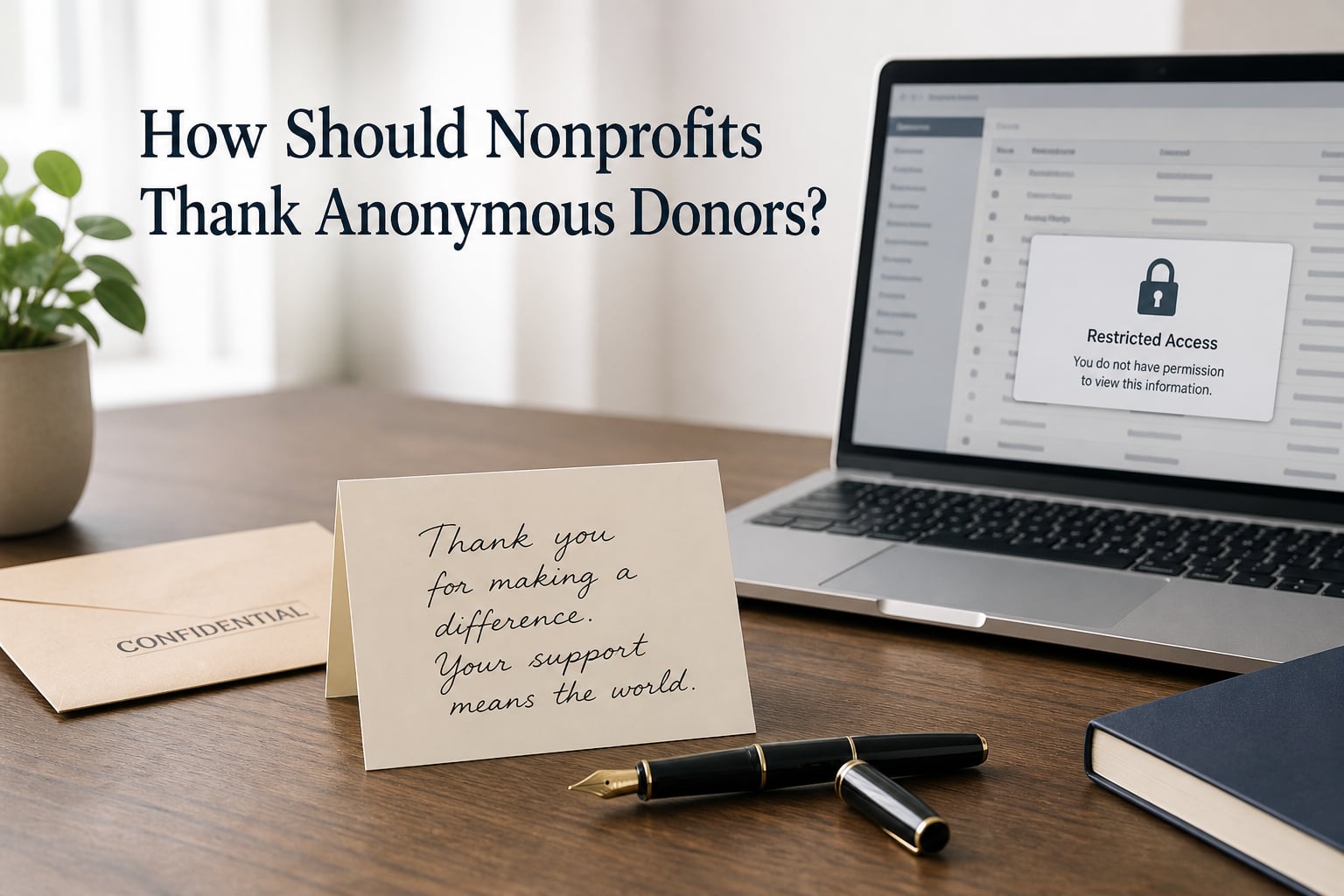
This is the heart of the question. Meaningful options for thanking anonymous donors include handwritten notes, personal phone calls, private emails, leadership outreach, and restricted database acknowledgments. Pick the channel that matches the gift size and what you know about the donor.
Handwritten Thank-You Notes
For gifts of any size, a handwritten thank-you note is the gold standard of donor appreciation. It signals that a real person, not a mail merge, read the gift. Keep the note short: thank them, mention the specific gift if you know it, and connect it briefly to the impact. Avoid promising public recognition, even subtly.
Personal Phone Calls From Leadership
For larger gifts, a personal phone call from the executive director or development director adds a layer of stewardship that email cannot match. In our experience, donors who give anonymously are often moved when a senior leader takes the time to call. Keep it brief, ask if they have questions, and listen more than you talk.
Private Emails and Direct Messages
If you have an email address but no name, send a private email that does not include any identifying details in the subject line or signature that would expose them. Use a generic organizational address like “[email protected]” rather than the name of a specific staff member. This is also the right channel for recurring donors who have set up monthly gifts through an online form.
Restricted Database Permissions
Inside your donor database, flag anonymous records with restricted permissions. Only staff who need to know should see the donor’s identity or contact information. Most CRMs (Salesforce NPSP, Neon One, DonorPerfect, Bloomerang) allow you to set per-record access. This protects the donor even if your staff grows or turns over.
Leadership Involvement
For major anonymous gifts, consider a private meeting with the CEO or board chair. A handshake from leadership, even off-site, communicates respect in a way no letter can. We have seen anonymous donors later become public advocates for an organization after a single, well-timed private meeting.
IRS Requirements for Thanking Anonymous Donors
The IRS still requires written acknowledgment for any charitable gift of $250 or more, regardless of whether the donor wants to remain anonymous. The acknowledgment must include the amount of cash, a description of any property, and a statement about whether the donor received any goods or services in return. The donor’s name does not have to appear on the public version of any document.
What the Acknowledgment Letter Must Contain
- The amount of money or a description of any property given
- Whether the donor received any goods or services in exchange (a quid pro quo disclosure)
- A statement describing any goods or services provided and their estimated value, when applicable
- The date the contribution was received
Quid Pro Quo Contributions
If the donor received anything of value in return, such as a ticket to a fundraising dinner, you must disclose the fair market value of that benefit. The deductible portion is the gift amount minus the benefit value. This applies whether the donor is named or anonymous.
Donor Advised Funds and Anonymous Gifts
When a Donor Advised Fund (DAF) makes a grant to your organization, the sponsoring fund administrator is the legal donor. You acknowledge the DAF, not the underlying person. This makes DAFs one of the easiest ways for wealthy donors to give anonymously while still providing documentation for your records.
No Goods or Services Provided
For a pure gift with no return benefit, your acknowledgment should include the exact phrase “No goods or services were provided in exchange for this donation.” That single line covers most standard acknowledgments and keeps you compliant.
Best Practices for Donor Stewardship When the Donor Is Anonymous
Ongoing stewardship matters even more for anonymous donors than for public ones, because they cannot see their name on a wall or in a report. Their continued giving depends entirely on whether they feel appreciated in private.
Keep Impact Reports Private
Send impact updates through the same private channel the donor used to give. If they gave by check, send a printed letter. If they gave online, send a private email. Do not put them on a general newsletter list that includes other donors.
Honor Anonymity in Annual Reports
If your annual report lists donors by name, segment it. Public donors can appear in the main listing. Anonymous donors can be grouped under categories like “Friends of the Mission” or listed with gift tier only. This honors the donor’s wish and keeps your reporting transparent.
Set Recurring Gift Acknowledgment
For donors giving monthly through your online form, set an automated private acknowledgment that goes out after each gift. Even a one-line “Thank you for your continued support, your August gift has been received” is enough. The key is consistency.
Use Restricted Database Permissions
Tag every anonymous record with a flag in your CRM. Limit who can see the donor’s identity to the executive director, development lead, and possibly the board treasurer. Audit access logs quarterly. This is one of the highest-leverage donor privacy habits a small nonprofit can adopt.
Match Leadership Involvement to Gift Size
A $50 anonymous monthly gift deserves a thank-you note. A $25,000 anonymous major gift deserves a phone call and possibly a private meeting with the CEO. Scale your stewardship to match the gift, just as you would with a public donor.
Acknowledging Untraceable Gifts: Cash and Money Orders
The hardest case is the gift that comes with no return address, no name, and no contact information at all. Cash left in a collection plate, a money order mailed to your office, or a donation dropped off anonymously at an event all fall into this bucket.
Even here, you have options for meaningful acknowledgment:
- Acknowledge in your general newsletter. A line like “We are grateful for the recent anonymous gifts that supported our summer program” recognizes the giver without naming them.
- Share with staff and board. Internal recognition still matters. Read the gift aloud at a staff meeting or share it in your board update.
- Save the gift communication. If the donor left a note, save it with the gift record. If they ever reveal themselves later, the note will be a powerful stewardship artifact.
- Use a public “Anonymous Friends” section. On your website, list a section for “Anonymous Friends of [Organization]” so the donor, if they ever look, sees themselves represented.
One disaster-relief nonprofit we follow posts a weekly thank-you on social media specifically for untraceable gifts. It has become one of their highest-engagement posts, and it has surfaced at least two anonymous donors who later gave again through traceable channels.
When to Decline or Restructure an Anonymous Donation
You are not obligated to accept every gift, named or anonymous. If the donor’s restrictions conflict with your mission, if the source of funds raises ethical red flags, or if the donor demands behavior that would compromise your independence, you can decline or restructure the gift.
Examples where declining is reasonable:
- The donor requires you to stop working on a program that is central to your mission.
- The funds come from a source your board has previously identified as inconsistent with your values.
- The donor demands ongoing control over staffing or program decisions.
- The donor wants anonymity but also wants public credit for the gift, which is not possible.
When in doubt, run the decision past your board’s governance or ethics committee. Document the conversation. Decline graciously, in writing, and offer to redirect the gift to a comparable organization if appropriate.
Frequently Asked Questions
How to thank anonymous donors?
Thank anonymous donors privately through handwritten notes, personal phone calls from leadership, private emails, and restricted database records. Match the channel to the gift size and avoid any public acknowledgment unless the donor explicitly requests it.
Can a nonprofit accept an anonymous donation?
Yes. Nonprofits can accept anonymous donations under US tax law. The IRS requires written acknowledgment for gifts of $250 or more, but the donor’s name does not need to be publicly disclosed. A board-approved gift acceptance policy protects both the donor and the organization.
How do I address an anonymous donor?
Use neutral language like Dear Friend, Dear Supporter, or Dear Partner in your acknowledgment letter. Avoid any phrasing that hints at identity. Do not include the donor’s name anywhere in the letter, on the envelope, or in your database export.
How to accept anonymous donations?
Accept anonymous donations by documenting them in your donor database with restricted access permissions, writing a board-approved gift acceptance policy, sending the required IRS acknowledgment for gifts of $250 or more, and limiting knowledge of the gift to a small leadership group.
Is it okay to not acknowledge an anonymous donor?
No. Every donor deserves acknowledgment, even those who choose to remain anonymous. Anonymous donors still want confirmation that their gift was received and used as intended. Skipping the thank-you risks losing the donor for future gifts.
How do you thank donors after a death in the family?
Send a brief handwritten condolence note acknowledging the recent gift and the loss. Avoid fundraising language entirely. If the donor was anonymous, do not name them. A simple, sincere message of gratitude for their support during a difficult time is enough.
Final Thoughts on Thanking Anonymous Donors
Learning how nonprofits thank anonymous donors well comes down to three habits: respect the donor’s privacy in every channel, scale your stewardship to the gift size, and keep your IRS documentation tight. Anonymous donors are often the most loyal supporters your nonprofit will ever have, precisely because they give without seeking credit. A prompt, private, sincere thank-you is the simplest way to keep them giving for years to come.
Start with one change this week. Add the restricted-access flag to your donor database, write a short board policy on anonymous gifts, and pick five recent anonymous donors to send a handwritten note to. Those three small steps will do more for your donor stewardship program than any software purchase.