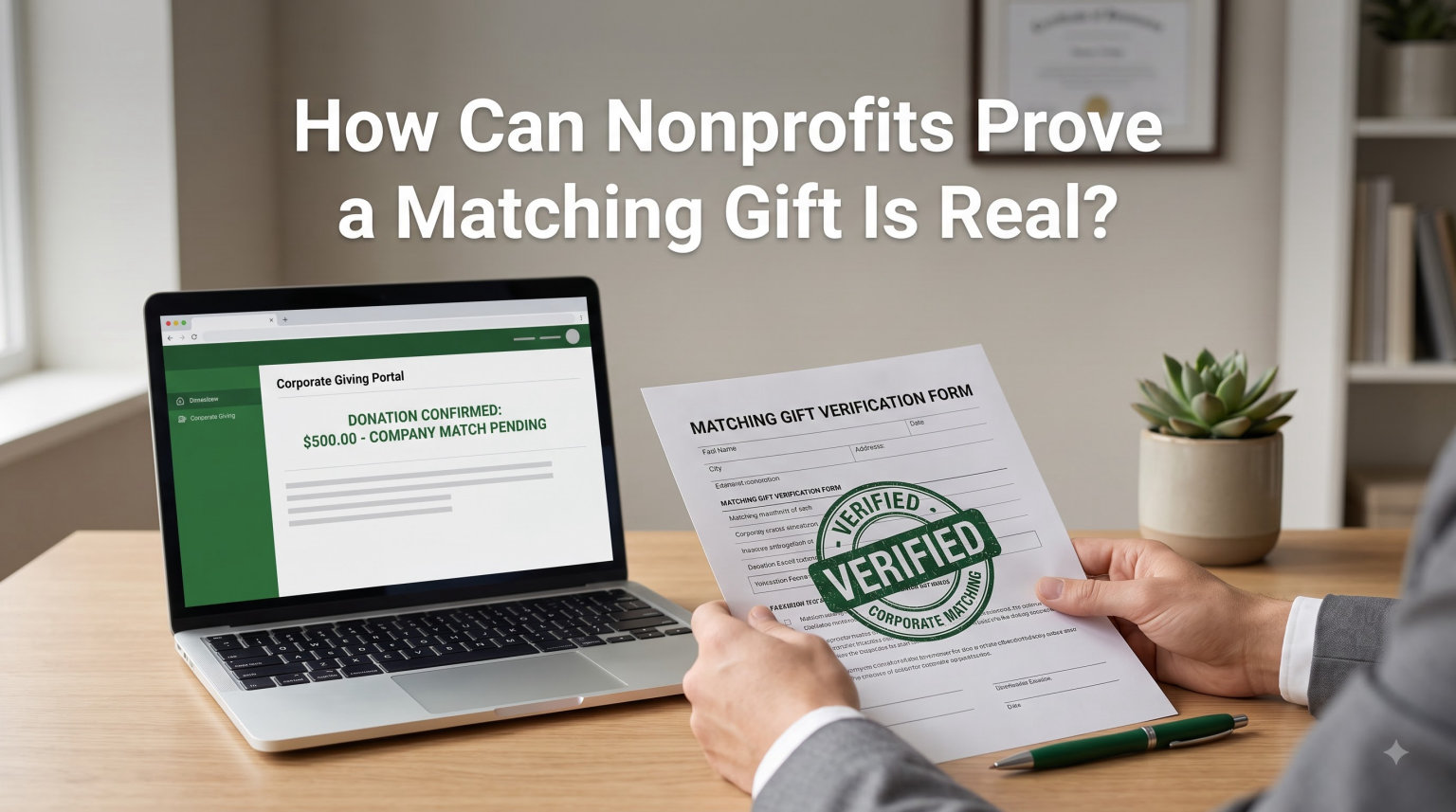
When a nonprofit says a donor will match your gift, the first question most people ask is simple: how do I know this is real? On forums like Reddit and Quora, the same skepticism shows up again and again. One donor asked, “How to tell if a charity is being honest when they claim your gift will be matched by an anonymous donor? Couldn’t they just be making this up?” Another wrote, “Every year, multiple 501c3s I donate to never confirm my donations, so they don’t get the match. It’s a major problem.” That skepticism is fair, and it costs nonprofits millions of dollars in unrealized matching revenue every year.
Our team works with nonprofits of every size, from local food banks to national advocacy organizations, and we have seen how the right documentation turns skeptical donors into recurring supporters. This guide walks through exactly how nonprofits can prove a matching gift is real, step by step. We will cover the standard verification process, the documentation required, and the specific language to use when a donor pushes back on authenticity. By the end, you will have a working playbook for matching gift verification at your organization.
Table of Contents
- 1What Are Matching Gifts and Why Donors Question Them
- 2How Can Nonprofits Prove a Matching Gift Is Real to Skeptical Donors
- 3Step-by-Step Verification Process for Nonprofits
- 4Documentation Requirements for Matching Gift Verification
- 5How to Respond When Donors Question Matching Gift Authenticity
- 6Best Practices for Record-Keeping and Proactive Communication
- 7Frequently Asked Questions
- 8Are matching gifts real?
- 9How do I confirm a non-profit is legit before donating?
- 10What is charitable gift matching?
- 11What is the 33% rule for nonprofits?
- 12Conclusion
What Are Matching Gifts and Why Donors Question Them
A matching gift is a donation made by a company or a third party that matches a donor’s original contribution to a nonprofit, usually dollar for dollar. Corporate matching gift programs are the most common type: an employee gives $100 to a charity, their employer donates another $100, and the nonprofit receives $200 for the cost of acquiring one donor gift. The American Association of Fundraising Counsel (AAFRC) estimates that corporate matching programs still leave roughly $4 billion to $7 billion unclaimed each year, partly because of friction in the matching gift verification nonprofit workflow.
Matching gifts do work, and they are a legitimate source of revenue for tens of thousands of charities. They are not some fringe gimmick. But donors have good reasons to question them. Charities sometimes promote “anonymous matching donor” campaigns where the matching donor’s identity, the cap on the match, and the timeline are all hidden. Those details matter, because a vague “your gift will be matched” claim without specifics can obscure whether a real pledge exists at all. Reddit users have called this out repeatedly: if a nonprofit cannot name the matching donor, show the match cap, or confirm the eligibility window, donors reasonably wonder if the match exists outside the marketing copy.
The fastest way to answer those doubts is documentation. A matching gift becomes undeniably real when a nonprofit can produce a 501c3 letter, an EIN confirmation, a written verification of the donation, and a clear record of the employer’s matching program eligibility. That is the core of any matching gift verification nonprofit process worth running.
How Can Nonprofits Prove a Matching Gift Is Real to Skeptical Donors
Proving that a matching gift is real comes down to producing proof a donor can verify on their own. Below are the five strongest pieces of evidence a nonprofit can put on the table. Any one of these, on its own, is more than most organizations currently provide to donors.
1. Provide the IRS 501c3 determination letter on request. A current 501c3 determination letter, paired with your EIN, lets any donor confirm your status using the IRS Tax Exempt Organization Search. This is the single most powerful proof of legitimacy a nonprofit can offer, and yet many development teams never share it unless asked.
2. Share the matching program rules in writing. If a corporate matching program is involved, you should be able to name the employer, confirm the match ratio (1:1, 2:1, or 0.5:1), state the annual per-employee cap, and identify the eligibility window. If a private individual is providing the match, ask them to sign a one-page letter that names the cap, the timeline, and the receiving organization. Donors trust what they can read.
3. Show your GuideStar or Candid profile. A current profile on GuideStar (now part of Candid) or a Charity Navigator listing provides third-party confirmation of your mission, your financials, and your governance. When a donor wants to “confirm a non-profit is legit,” send them straight to these profiles rather than expecting them to dig.
4. Issue written donation confirmations quickly. Speed and form both matter. A receipt or acknowledgment letter that includes the donor’s name, the donation amount, the date, the EIN, and the nonprofit’s signature should go out within 48 hours of the gift. Many corporate matching gift requests stall because the nonprofit confirmation never arrives. One Reddit user captured the problem clearly: “Multiple 501c3s I donate to never confirm my donations, so they don’t get the match.”
5. Offer to share the matching donor’s identity when appropriate. Anonymous matches are a marketing tradition, but they are also the single biggest source of donor skepticism. Where you can share the matching donor’s name (with their permission), the match becomes far more credible. Where you cannot, be specific about the terms in writing.
Step-by-Step Verification Process for Nonprofits
Here is a seven-step workflow we recommend for any matching gift verification nonprofit process. Follow it from the moment a donor gives, and you will close the documentation gaps that frustrate corporate match programs.
Step 1: Capture employer data at the point of donation. Add a simple “company name” field to your online donation form. Knowing where the donor works lets you flag the gift for matching eligibility and follow up with the right paperwork. Roughly 65% of matching gift revenue is lost because the nonprofit never collects this data, according to industry research.
Step 2: Send an immediate acknowledgment email. Include the donation receipt, the EIN, the 501c3 letter, and a brief note explaining how the donor can request a match.
Step 3: Match the donor to their employer’s program. Use a matching gift database (Double the Donation, HEPdata, or 360MatchPro) to look up eligibility, the match ratio, and the submission steps.
Step 4: Help the donor submit the match request. Send the donor a direct link to their employer’s portal, the form fields they will need, and the documentation your team can provide.
Step 5: Confirm the donation through the employer’s portal. Many corporate portals send a verification request to the nonprofit. Have a staff member designated to respond within two business days.
Step 6: Track the match payment. Create a status field in your CRM (pending, verified, paid). Follow up with the employer if a payment is more than 90 days late.
Step 7: Thank the donor and the matching company. Send a separate acknowledgment when the match arrives. Recognition drives repeat giving.
Documentation Requirements for Matching Gift Verification
Documentation is the engine of any matching gift verification nonprofit workflow. If you cannot produce these documents on demand, you will struggle to prove authenticity to a skeptical donor. Here is the full list we recommend keeping on file, organized by purpose.
For proving nonprofit legitimacy: keep your IRS 501c3 determination letter on file and ready to email, your most recent Form 990, your EIN, your state charity registration, and a current GuideStar or Candid profile.
For matching gift processing: keep the donor’s original gift record (date, amount, channel), the employer’s matching gift program rules, the match ratio, the cap, the submission deadline, a copy of the donation receipt sent to the donor, and the verification letter your team sends back to the employer’s portal.
For matching gift authenticity claims: keep written correspondence from any third-party matching donor, including the cap, the timeline, and the disbursement method. If a private match is anonymous, ask the donor to provide a signed statement confirming the pledge, even if their name is omitted publicly.
For tax and audit purposes: keep the ACH or check record for any corporate match payment, the date the match was received, the amount, and the originating employer’s name. These records protect you during an audit and let you respond to any donor question about where the money came from.
The single biggest documentation failure we see is missing employer data. If a donor never tells you where they work, and you never ask, the match is unrecoverable.
How to Respond When Donors Question Matching Gift Authenticity
Even with great documentation, some donors will push back. They have been burned by vague claims in the past, and they want to know exactly what is and is not real. The right response combines empathy with specific proof. Below are four scenarios we have coached teams through, with sample language you can adapt.
Scenario 1: “How do I know the matching donor really exists?”
Lead with the document. Say: “Here is a one-page letter from the matching donor confirming the cap, the timeline, and the receiving organization. If you would like, I can also share the donation receipt from your gift.” Specifics win trust.
Scenario 2: “Why is the matching donor anonymous?”
Be honest. Say: “Many major donors prefer to remain anonymous for privacy or family reasons, but I have a written pledge on file with the match cap and terms. I can share that letter with you, redacted where needed.”
Scenario 3: “How will I know my employer actually sent the match?”
Set expectations up front. Say: “Once your match is approved by your employer, we will email you the date and amount. If we receive the match after 90 days, I will personally follow up with the company.”
Scenario 4: “Why should I believe your nonprofit is real?”
Do not take it personally. Say: “Great question. Here is our IRS 501c3 letter, our EIN, our GuideStar profile, and a copy of our most recent annual report. I am also happy to put you on the phone with our executive director.”
The pattern in every scenario is the same: acknowledge the concern, lead with proof, and offer a human contact. That combination moves a suspicious donor to a confident giver more reliably than any slogan.
Best Practices for Record-Keeping and Proactive Communication
Skeptical donors are not just a reaction problem. They are often a symptom of weak record-keeping and inconsistent communication. Build these habits into your development workflow and the next round of donor questions will be much easier to handle.
Capture employer data at every donation. A donor’s company is the single most important piece of context for matching gift eligibility, and most nonprofits fail to collect it. Add it to your form, your CRM, and your pledge receipts.
Centralize your matching gift documentation. Keep all matching gift records in one folder or one CRM view, tagged by donor, employer, and status. Sifting through email chains wastes hours that an organized system saves.
Send proactive verification updates. Most donors hear nothing until a match arrives months later. Send a quick note when the match request is submitted, when it is approved, and when the payment arrives. Three updates per match builds trust.
Audit a sample of closed matches each quarter. Pick five closed match records per quarter and verify that every document is on file. Audits catch the gaps before an external auditor or a skeptical donor does.
Train every gift officer on the verification process. Donor-facing staff should know exactly which documents to offer, in what order, and how to access them. One impromptu answer from a confused staff member can undo a season of careful stewardship.
These five habits do not require new technology. They require consistency. Once embedded, they prevent most of the donor questions that waste your team’s time today.
Frequently Asked Questions
Are matching gifts real?
Yes. Matching gifts are real, and corporate matching gift programs distribute an estimated $4 billion to $7 billion in matched donations every year, much of which goes unclaimed. When a nonprofit says your gift will be matched, the match is a binding commitment from an employer or another donor, and you can verify it by asking for the program rules, the cap, and a written confirmation.
How do I confirm a non-profit is legit before donating?
Confirm a non-profit is legit by checking three things: the IRS 501c3 determination letter and EIN using the IRS Tax Exempt Organization Search Tool, a current profile on GuideStar (Candid) or Charity Navigator, and the state charity registration in the state where the nonprofit operates. Any 501c3 in good standing will share these documents on request.
What is charitable gift matching?
Charitable gift matching is a program where an employer or a third party matches a donor’s gift to a qualifying nonprofit, most commonly at a 1:1 ratio. The donor gives $100, the company gives another $100, and the nonprofit receives $200. Programs vary by employer, with caps ranging from $500 to $50,000 per employee per year.
What is the 33% rule for nonprofits?
The 33% rule is a fundraising benchmark suggesting that no single donor should account for more than roughly one-third of a nonprofit’s annual contributions. It is not a legal requirement, but it is a useful governance guideline because a heavy reliance on one donor (or one matching donor) creates revenue concentration risk. Verifying your matching gift claims transparently supports this principle.
Conclusion
Donor skepticism toward matching gifts is not a perception problem you can talk your way out of. It is a documentation problem you can solve. The nonprofits that consistently clear large amounts of matching revenue are the ones that treat verification as part of the gift, not an afterthought. They send the donation receipt within 48 hours, they respond to employer verification requests inside two business days, they keep their 501c3 letter and EIN one click away, and they are willing to share the matching donor’s identity when they can.
If your team takes one action this week, make it this: build a seven-step matching gift verification nonprofit checklist and assign it to a named owner. The owner can be a development associate, a database manager, or the executive director. What matters is that someone owns the workflow end to end. Once that owner is in place, the documentation gaps that frustrate donors and employers will close, and the matching gift claims you put in front of donors will finally carry the proof they deserve.
For more guidance on nonprofit verification, donor stewardship, and matching gift program strategy, explore the rest of the AAFRC resource library. We publish practitioner-focused guidance throughout the year, and we welcome your questions about the specific verification challenges your team is facing.