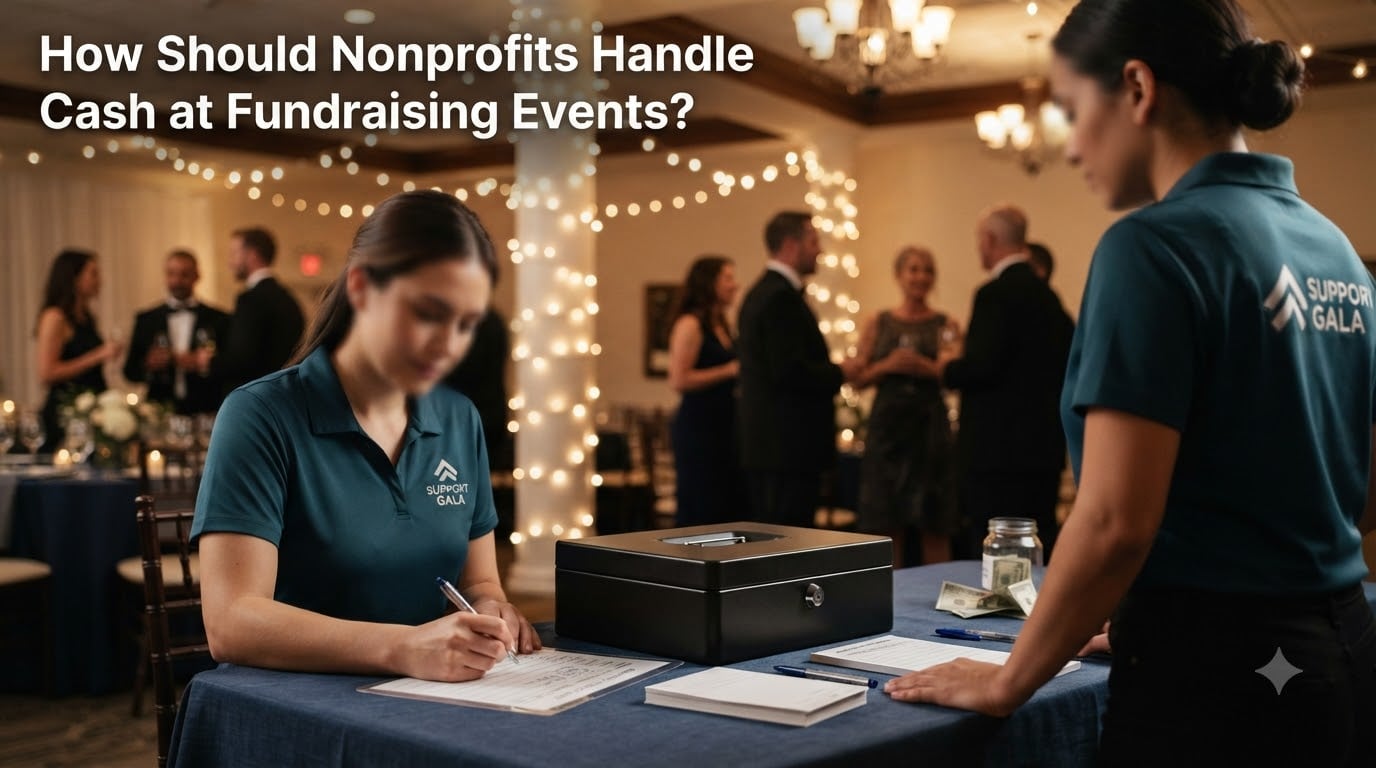
Running a fundraising event means dealing with cash outside your normal office environment, where the usual safeguards are harder to enforce. Most contributions come by check or credit card, but every gala, raffle, and bake sale still generates cash that needs protection. If your team does not have documented procedures, that money is vulnerable to theft, errors, and compliance issues. In this guide, we break down exactly how nonprofits handle cash fundraising events, from pre-event planning through the final bank deposit.
Table of Contents
- 1Why Cash Handling Matters at Fundraising Events
- 2Build a Cash Handling Policy Before the Event
- 3Set Up Cash Boxes and Assign Personnel
- 4Apply Dual Control: The Two-Person Rule
- 5Count, Reconcile, and Document Every Dollar
- 6Make Prompt and Verified Bank Deposits
- 7Train Staff and Volunteers on Cash Procedures
- 8Common Mistakes to Avoid at Fundraising Events
- 9FAQs
- 10What is the 33% rule for nonprofits?
- 11What is the 80 20 rule in fundraising?
- 12How to raise money at a fundraising event?
- 13What is the 3 to 1 rule for fundraising?
- 14Wrapping Up: Cash Controls That Protect Your Mission
Why Cash Handling Matters at Fundraising Events
Cash is the hardest asset to track because it leaves no automatic paper trail like a credit card or bank transfer. At fundraising events, this risk multiplies because you are working off-site, relying on volunteers, and juggling multiple revenue streams at once. A single missing cash box or uncounted donation can create audit findings, erode donor trust, and even threaten your tax-exempt status if patterns of mismanagement emerge.
Our team has seen small nonprofits lose hundreds of dollars at a single event simply because nobody was assigned clear responsibility for the cash box. The fix is not complicated, but it does require planning before the doors open. Strong cash handling procedures protect your organization, your staff, and your mission.
The core principle is simple: create separation between the people who collect cash, count it, and deposit it. When no single person controls the entire flow, the opportunity for theft or error drops dramatically.
Build a Cash Handling Policy Before the Event
Every nonprofit should handle cash at fundraising events by starting with a written policy that everyone understands before the event begins. A documented cash handling policy removes guesswork and gives volunteers clear instructions to follow.
Your policy should answer six questions in advance:
1. Who is authorized to handle cash at the event?
2. Which activities will generate cash (ticket sales, auctions, raffles, concessions)?
3. Where will cash be stored and secured during the event?
4. How and when will cash be counted?
5. Who is responsible for making the bank deposit?
6. What documentation will be collected for every transaction?
If your event includes quid pro quo donations, where donors receive goods or services worth more than $75 in exchange for their contribution, you must provide written disclosures stating the deductible portion. Build this into your ticketing and payment process so it never gets missed in the rush of the event.
Walk through the full transaction flow on paper before event day. Identify each point where cash changes hands, then assign a control to that point. This exercise reveals gaps that you can fix before they cost you money.
Set Up Cash Boxes and Assign Personnel
Each revenue-generating activity at your event should have its own separate cash box. When all the money goes into one shared box, you lose the ability to trace discrepancies back to their source. Separate boxes let you reconcile each station independently.
Here is how to set up each cash box properly:
1. Pre-count and record the startup cash (change fund) in each box before the event.
2. Assign one specific person to manage each box for the duration of their shift.
3. Tape a copy of the cash handling directions inside the lid of each box.
4. Use a sign-out log so every person who takes possession of a box signs their name and the time.
5. Have a designated oversight person who is not running a station rotate between booths to check on cash levels.
Limit the number of people who touch each cash box. The fewer hands involved, the easier it is to trace problems. If you need to move cash from a station to a secure location during the event, always send two people together.
Keep a locked drop safe or secure bag in a designated location where excess cash can be stored during the event. Cash boxes should never hold more than necessary. When a box builds up beyond what is needed for change, transfer the surplus to the locked location.
Apply Dual Control: The Two-Person Rule
Dual control means that no single person is ever alone with event cash. This is the single most important internal control for nonprofits handling cash at fundraising events. It protects the organization from both actual theft and false accusations.
Dual control applies to every stage of the cash cycle:
1. Two people should be present whenever cash is collected at a station.
2. Two people must transport cash from the event to a secure storage location.
3. Two people count the cash together at the end of the event.
4. Two people should verify the deposit amount before it goes to the bank.
Segregation of duties goes beyond just pairing people up. The person who collects cash should not be the same person who counts it or deposits it. When collection, counting, and depositing are handled by different individuals, any discrepancy surfaces quickly because each person serves as a check on the others.
This separation can be hard for small nonprofits with limited staff. If you only have two employees, bring in a board member or trusted volunteer to serve as the independent counter. The key is that the counter must not have had access to the cash box during the event.
Count, Reconcile, and Document Every Dollar
Cash reconciliation is the process of comparing what you expected to collect against what you actually collected. This step catches errors, missing funds, and discrepancies before they become bigger problems. Every dollar should be documented with count sheets, receipts, and logs.
Follow this counting procedure after the event:
Step 1: Move all cash boxes to a secure, private room away from the event crowd.
Step 2: Two designated people open each box together and count the contents.
Step 3: One person counts while the other records the amounts on a cash count sheet.
Step 4: Subtract the startup change fund from the total to determine net revenue.
Step 5: Compare the net revenue against ticket logs, inventory sold, and expected donations.
Step 6: Both counters sign and date the count sheet.
Step 7: Investigate any discrepancy before leaving the room.
Keep a receipt book at every cash station and issue receipts for donations whenever possible. For ticketed events, reconcile the number of tickets sold against the cash collected. If you sold 200 tickets at $50 each, the cash count should reflect $10,000 plus any startup change fund.
If your event included concession sales or merchandise, perform inventory reconciliation too. Count what you started with, subtract what is left, and verify that the sold quantity matches the cash collected. This catches both shortages and overcharges.
Document everything. Cash count sheets, ticket logs, deposit slips, and receipt books should be filed together and retained for your records. These documents create an audit trail that proves your internal controls are working.
Make Prompt and Verified Bank Deposits
Event cash should be deposited in a bank as soon as possible after the event ends, ideally the same day or the next morning. The longer cash sits in an office or someone’s home, the greater the risk of loss or theft. Make daily deposits a non-negotiable rule.
The person who makes the deposit should not be the same person who collected or counted the cash. This final layer of separation ensures that the deposit amount is independently verified by someone who was not part of the earlier steps.
Use these deposit best practices:
1. Prepare a separate deposit slip for each cash box or activity station.
2. Attach the signed count sheet to the corresponding deposit slip.
3. Have a third person review the deposit slip against the count sheet before the deposit is made.
4. Obtain a stamped deposit receipt from the bank and file it with your event records.
5. For events with large amounts of cash, consider using an armored car service or night deposit drop.
Never use event cash to pay event expenses, make purchases, or reimburse staff. All expenses should go through your normal accounting process with proper documentation. Mixing organizational funds with personal money, even temporarily, creates serious compliance problems.
Train Staff and Volunteers on Cash Procedures
Volunteers are often the ones handling cash at fundraising events, and most have no experience with financial controls. A brief training session before the event makes a measurable difference in accuracy and accountability.
Cover these essentials in your volunteer briefing:
1. Review the cash handling policy and distribute a one-page quick reference guide.
2. Demonstrate how to make change and organize bills in the cash box.
3. Explain the sign-out log and why every cash transfer must be recorded.
4. Walk through what to do if the cash box runs low on change.
5. Make clear that no personal purchases may be made from event cash.
6. Show volunteers how to issue receipts and record donations.
Pair each new volunteer with an experienced cash handler for their first shift. This mentorship approach reduces errors and gives volunteers confidence. Keep the training short, practical, and focused on the specific tasks they will perform.
After the event, hold a brief debrief meeting with your cash handling team. Discuss what worked, what did not, and what procedures need adjustment before the next event. This continuous improvement loop is something most nonprofits skip, but it makes each event safer and smoother than the last.
Common Mistakes to Avoid at Fundraising Events
Even experienced nonprofits make predictable errors when handling cash at events. Being aware of these pitfalls helps you avoid them.
Leaving cash boxes unattended, even briefly, is the most common mistake. A volunteer steps away for a break and the box sits open on a table. Always close and lock the box, and have a relief person ready before breaks.
Using one combined cash box for multiple stations is another frequent problem. When everything goes into one pool, you cannot tell which station had a shortage. Separate boxes are worth the extra setup time.
Skipping the reconciliation step because everyone is tired after the event is dangerous. Discrepancies are much harder to investigate the next day when memories have faded. Count and reconcile before anyone goes home.
Failing to document verbal donations or informal contributions creates gaps in your records. Every cash receipt, no matter how small, should be written down.
FAQs
What is the 33% rule for nonprofits?
The 33% rule suggests that nonprofits should spend no more than one-third of their total budget on fundraising and administrative costs combined, with at least two-thirds going directly to programs. While not a legal requirement, this benchmark helps donors evaluate efficiency. The IRS does not enforce a specific ratio, but maintaining strong internal controls over fundraising revenue keeps your administrative costs lower and your program ratio healthier.
What is the 80 20 rule in fundraising?
The 80 20 rule in fundraising states that roughly 80% of your donations come from 20% of your donors. This principle highlights why major gift cultivation matters, but it also applies to event revenue, where a few large donations often outweigh many small cash contributions. Understanding this pattern helps you allocate staff attention and cash handling resources where they have the most impact.
How to raise money at a fundraising event?
To raise money at a fundraising event, offer multiple revenue streams such as ticket sales, live or silent auctions, raffles, donation appeals, and merchandise sales. Assign separate cash boxes to each revenue station, train volunteers on collection procedures, and use dual control for all cash handling. Provide clear payment options including cash, check, and card processing so donors can give in whatever way is easiest for them.
What is the 3 to 1 rule for fundraising?
The 3 to 1 rule for fundraising means that a successful event should raise at least three dollars for every one dollar spent on event costs. This ratio ensures the event generates meaningful net revenue rather than just breaking even. Tracking every dollar in and out with proper cash handling procedures gives you the accurate numbers needed to calculate this ratio and decide whether an event is worth repeating.
Wrapping Up: Cash Controls That Protect Your Mission
Knowing how nonprofits handle cash at fundraising events comes down to a few proven principles: write your policies before the event, use separate cash boxes, apply dual control at every stage, document every dollar, and deposit promptly. These procedures work for organizations of any size, and they give your donors, board, and auditors confidence that you take financial responsibility seriously. Start with a simple one-page cash handling guide, train your team, and refine your process after every event.
1 thought on “Nonprofit Cash Handling at Fundraising Events (2026)”