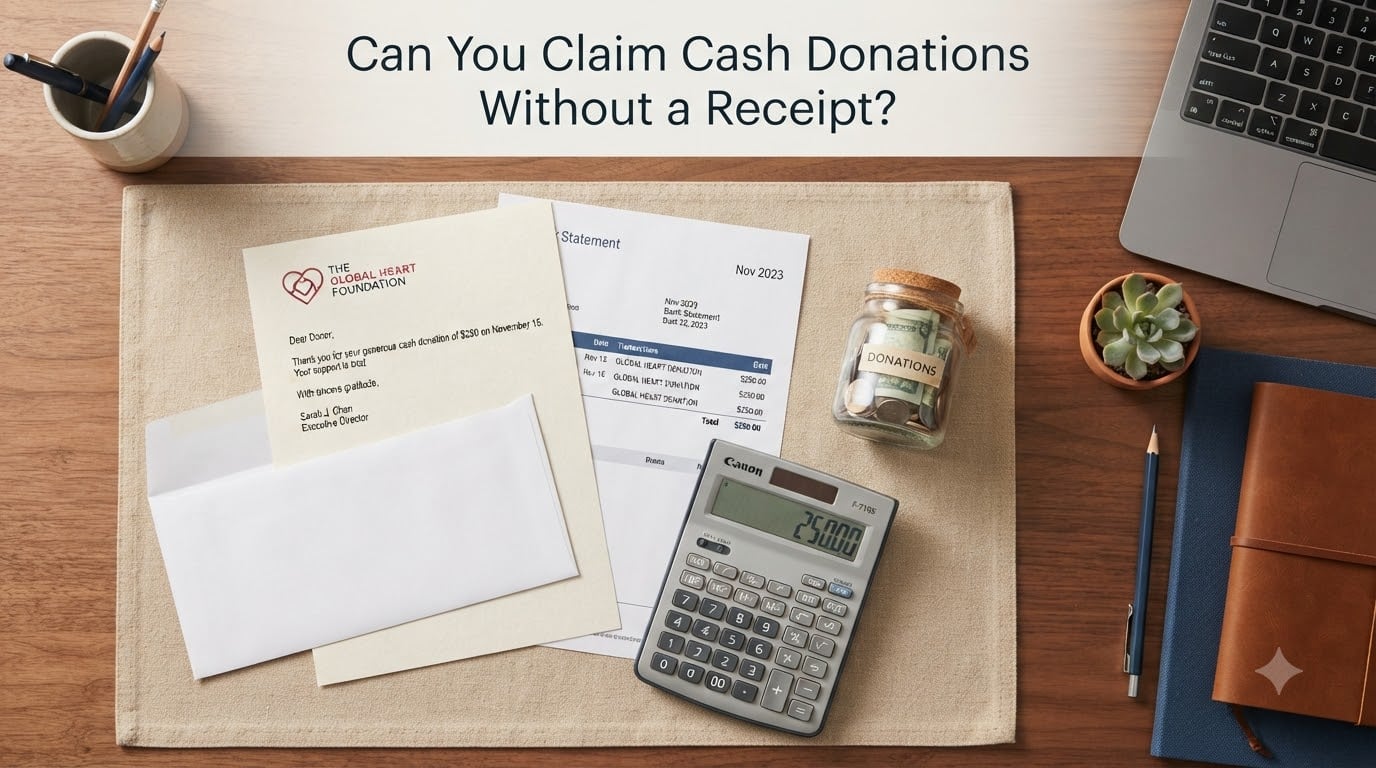
Yes, you can claim cash donations without a traditional receipt, but only under specific conditions. The IRS allows taxpayers to deduct cash contributions under $250 using bank records instead of a formal receipt. For donations of $250 or more, the IRS requires a contemporaneous written acknowledgment from the charity. Understanding these thresholds protects your deduction and keeps you on the right side of the tax code.
I have worked through hundreds of donation scenarios with our team, and the confusion around receipt rules causes more lost deductions than almost anything else. Let me walk you through exactly how the IRS handles cash donation documentation in 2026.
Table of Contents
- 1Can You Claim Cash Donations Without a Receipt?
- 2What Records Count as Proof for Cash Donations Under $250?
- 3Do Digital Payment App Records Count as Bank Records?
- 4When Do You Need a Written Acknowledgment for a Donation?
- 5What Counts as a Qualified Charitable Organization?
- 6How the IRS Checks Cash Donations and Audit Risk
- 7What to Do If You Lost Your Donation Receipt
- 82026 Tax Law Changes: The Universal Deduction
- 9Frequently Asked Questions About Cash Donation Receipts
- 10How much can you write off for cash donations without a receipt?
- 11How much donations can I claim without receipts?
- 12How does the IRS check cash donations?
- 13What donations can I claim without proof?
- 14Final Thoughts on Claiming Cash Donations Without a Receipt
Can You Claim Cash Donations Without a Receipt?
You can claim cash donations without a receipt when the total contribution to a single charity is less than $250 for the tax year. The IRS requires some form of documentation for every cash donation, but a formal receipt is not the only acceptable proof.
For donations under $250, the IRS accepts a bank record showing the donation. This includes a canceled check, a bank statement, or a credit card statement that clearly identifies the charity’s name, the donation date, and the amount. The same rule applies to digital payment apps like PayPal, Venmo, and Zelle, as long as the transaction record names the charity as the recipient.
For donations of $250 or more, a receipt alone is not enough. The IRS requires a contemporaneous written acknowledgment from the charity, which means the charity must provide the document before you file your tax return. Bank records do not substitute for this acknowledgment.
What Records Count as Proof for Cash Donations Under $250?
The IRS defines a “bank record” broadly. Any reliable document from your bank, credit card issuer, or payment processor that proves the donation qualifies.
Here are the records the IRS accepts for cash donations under $250:
- Canceled checks with the charity name written in the memo line
- Bank statements showing electronic transfers to the charity
- Credit card statements identifying the charity as the merchant
- Savings account passbooks with entries for withdrawals to the charity
- Digital payment app records from Venmo, PayPal, Cash App, or Zelle showing the charity as recipient
- Online banking transaction histories with screenshots or printouts
I recommend downloading a PDF copy of each donation record the moment you make the contribution. Our team learned this the hard way after a client lost their bank statements and spent weeks reconstructing records for an audit.
The record must clearly show three things: the name of the charity, the date of the donation, and the dollar amount. If any of these details are missing, the IRS may disallow the deduction.
Do Digital Payment App Records Count as Bank Records?
Digital payment app records from services like Venmo, PayPal, Cash App, and Zelle count as bank records for cash donations under $250. The transaction history showing the charity as the recipient serves as documentation.
The key requirement is that the payment must go directly from you to a qualified charity’s account, not to an individual who then forwards the funds. Keep the confirmation email or screenshot showing the recipient is the charity itself.
When Do You Need a Written Acknowledgment for a Donation?
You need a contemporaneous written acknowledgment from the charity for any single donation of $250 or more. The IRS applies this rule per donation, not as an annual total, so even a one-time gift of $250 triggers the requirement.
A valid acknowledgment must include:
- The amount of cash contributed
- A statement that no goods or services were received in return (or a description and value of any items received)
- The charity’s name
- The date of the contribution
“Contemporaneous” means the charity must provide the acknowledgment before you file your tax return and no later than the date you file. For most people, that deadline is April 15. If you file for an extension, you have until the extended due date.
Note that the acknowledgment does not need to say “contemporaneous written acknowledgment.” The charity’s regular thank-you letter satisfies the requirement as long as it includes the amount and the statement about goods or services.
What Counts as a Qualified Charitable Organization?
A qualified charitable organization is one that the IRS has approved to receive tax-deductible contributions. The organization must hold 501(c)(3) status or be a specific type of government entity, religious organization, or educational institution.
Common qualified organizations include:
- Churches, synagogues, mosques, and other religious institutions
- Nonprofit hospitals and medical research organizations
- Public schools and state universities
- Public charities like the Red Cross, United Way, and Salvation Army
- Donor-advised funds held by qualifying sponsoring organizations
Donations that do not qualify include those made directly to individuals, political campaigns, political action committees, foreign charities (generally), and most for-profit businesses. Cash gifts to a GoFundMe for a neighbor’s medical bills, for example, do not qualify, even though the cause may be worthy.
You can verify whether a charity is qualified using the IRS Tax Exempt Organization Search tool. I check every new charity before recommending a donation to clients, and it takes less than two minutes.
How the IRS Checks Cash Donations and Audit Risk
The IRS checks cash donations primarily by reviewing the documentation you submit with Schedule A of Form 1040. For audits, examiners compare claimed donations against available third-party data, including Form 1099-K reports from payment platforms and Form 8283 filings for noncash gifts.
For larger cash donations above $5,000, the charity itself is required to report the gift on Form 8282 if the donated property is sold within three years. For cash, however, the reporting burden falls almost entirely on the donor.
Audit risk for cash donations without receipts is higher when the amounts are unusually large compared to income, when donations cluster at specific charities, or when the taxpayer has other red flags like self-employment income. Still, documented cash donations under $250 with clear bank records carry low audit risk in my experience.
If you make significant cash donations, our team recommends keeping records for at least seven years. The IRS generally has three years to audit a return, but can extend that to six if substantial understatement is suspected.
What to Do If You Lost Your Donation Receipt
If you lost your donation receipt, you can still claim the deduction in most cases. For donations under $250, your bank statement or credit card statement replaces the receipt entirely. For donations of $250 or more, you will need to contact the charity and request a duplicate acknowledgment.
Follow these steps to reconstruct lost donation records:
- Pull your bank and credit card statements from the relevant tax year
- Identify all transactions paid to qualified charities
- For any donation over $250, contact the charity’s finance office and request a duplicate acknowledgment letter
- Compile the bank records and replacement acknowledgments into a single donation folder
- Cross-reference your compiled records against any year-end giving summaries the charity sent you
Most charities can reissue an acknowledgment quickly because they keep donor records on file. I have seen duplicate letters arrive within three business days when donors contact the development office directly.
2026 Tax Law Changes: The Universal Deduction
Starting in 2026, taxpayers who do not itemize can claim an above-the-line charitable deduction of up to $1,000 for single filers and $2,000 for married couples filing jointly. This new universal deduction makes cash donations more valuable for the roughly 87% of taxpayers who take the standard deduction.
The $250 receipt rules still apply to this new deduction. You must have bank records for cash gifts under $250, or a contemporaneous written acknowledgment for gifts of $250 or more. Cash donations to nonqualified organizations remain nondeductible.
This change means more people can benefit from charitable giving at tax time. Our team has been tracking the rollout, and we expect donation software and payroll giving programs to integrate the new deduction throughout 2026.
Frequently Asked Questions About Cash Donation Receipts
How much can you write off for cash donations without a receipt?
You can write off cash donations under $250 per charity per year without a formal receipt, as long as you have a bank record showing the charity name, donation date, and amount. Canceled checks, bank statements, and credit card statements all qualify. For donations of $250 or more, the IRS requires a contemporaneous written acknowledgment from the charity.
How much donations can I claim without receipts?
The IRS requires some form of documentation for every cash donation, but you can claim unlimited cash donations under $250 without a receipt from the charity, as long as you have bank records. The threshold applies per donation to a single charity, not as an annual cap. Anything above $250 requires a written acknowledgment before you file your return.
How does the IRS check cash donations?
The IRS checks cash donations by reviewing your Schedule A documentation, comparing claimed gifts against Form 1099-K reports from payment platforms, and requesting third-party verification during audits. For donations above $5,000, charities may report related property sales on Form 8282. Strong bank records and acknowledgments are the best defense.
What donations can I claim without proof?
No charitable donation can be claimed without some form of proof. The IRS requires documentation for every cash gift, whether it is a bank record under $250 or a written acknowledgment for $250 or more. The closest exception is the new universal above-the-line deduction in 2026, which still requires the same supporting records.
Final Thoughts on Claiming Cash Donations Without a Receipt
You can claim cash donations without a traditional receipt as long as you stay under the $250-per-donation threshold and have solid bank records to back each gift. Above $250, a contemporaneous written acknowledgment from the charity becomes mandatory, and no other document substitutes for it.
Our team recommends setting up a dedicated folder for donation records at the start of each year. Save your bank statements, screenshots from payment apps, and any acknowledgment letters in one place. When tax season arrives, you will have everything ready, and your charitable deduction will stand up to scrutiny.
For 2026, remember the new universal deduction that lets non-itemizers deduct up to $1,000 ($2,000 for joint filers) in cash donations. Whether you itemize or not, keeping clean records is the single best habit for protecting your charitable contributions at tax time.