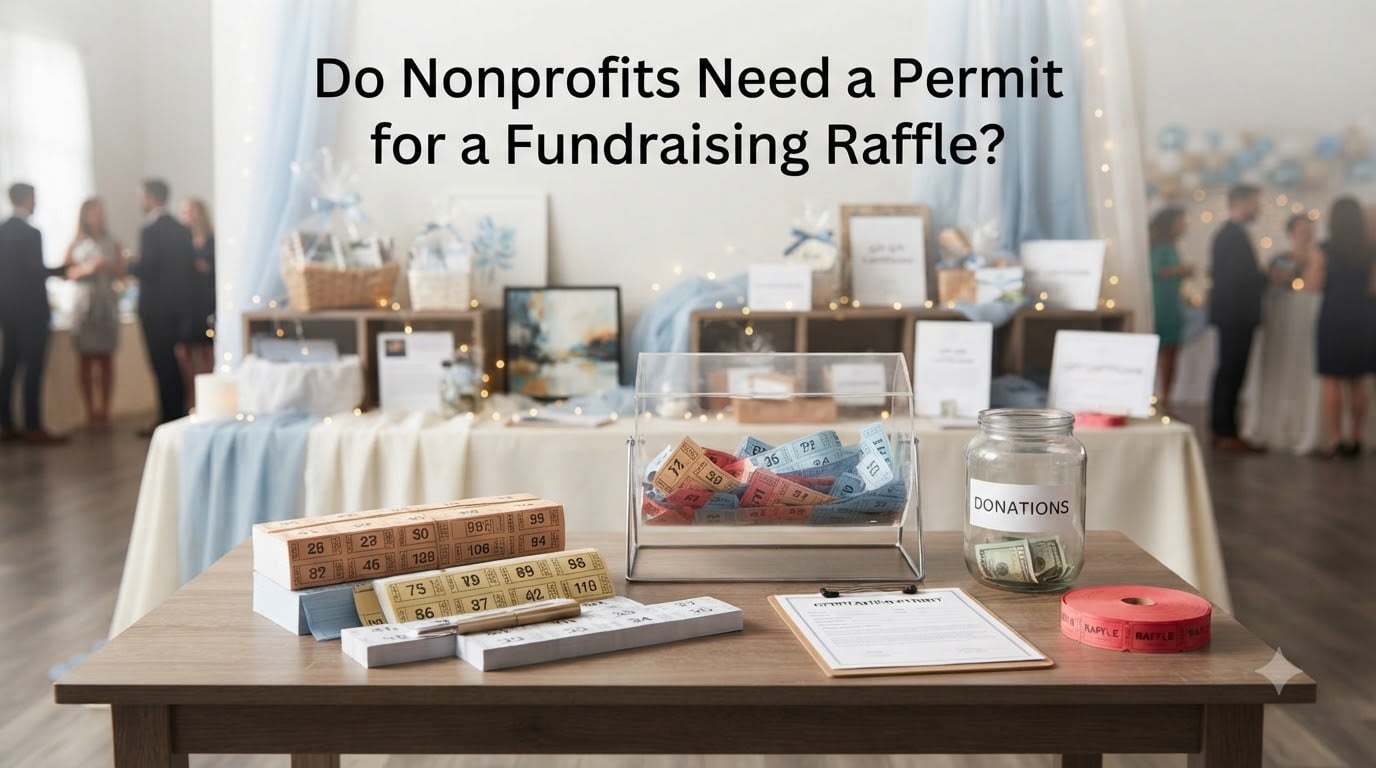
Whether you are planning a church fundraiser, a school drawing, or a civic club 50/50 raffle, the same question comes up fast: do nonprofits need a permit for a fundraising raffle?
The honest answer is that it depends almost entirely on your state, the type of organization you operate, and the dollar value involved. Raffles are legal for nonprofits in 47 of 50 states, but the permit requirements, eligibility rules, and reporting obligations vary so much that one organization’s simple event can be another’s compliance headache.
I have spent years watching boards and volunteer committees get tripped up by exactly these rules. The most common mistake is assuming that because a raffle is “for charity,” no paperwork applies. That assumption is the fastest route to fines, revoked permits, and in some states, criminal exposure for board members.
This guide walks through every layer of the question: what qualifies as a raffle under the law, which organizations can run one, how to apply for a nonprofit fundraising raffle permit, what the IRS expects, and what happens after the drawing. By the end, you should know exactly what to do next and where to look for your state’s specifics.
Table of Contents
- 1The Short Answer: Yes, Most Nonprofits Need a Permit
- 2What Is a Nonprofit Fundraising Raffle and How Is It Legally Defined?
- 3Do Nonprofits Need a Permit for a Fundraising Raffle in Every State?
- 4Raffle vs. Promotion vs. Drawing: Legal Differences Explained
- 5Which Organizations Qualify to Run a Charitable Raffle?
- 6How to Apply for a Nonprofit Raffle Permit: Step-by-Step
- 7IRS Rules, Tax Implications, and Donor Deduction Rules
- 8Record Keeping and Post-Raffle Reporting Requirements
- 9Online Raffles and 50/50 Drawings: Special Considerations
- 10Common Mistakes to Avoid When Running a Nonprofit Raffle
- 11FAQs
- 12Do nonprofits need a raffle license?
- 13How to hold a raffle without calling it a raffle?
- 14What are the rules for nonprofit raffles in Texas?
- 15Can a non-profit do a fundraiser?
- 16Can a non-profit hold a raffle?
- 17What is the legal difference between a raffle and a drawing?
- 18Conclusion: Plan Early, Verify Locally, Document Everything
The Short Answer: Yes, Most Nonprofits Need a Permit
In the majority of states, qualified nonprofits do need a permit, license, or registration to hold a charitable raffle. Only a handful of states treat small or occasional raffles as exempt, and only three states prohibit charitable raffles outright.
Here is the quick breakdown:
47 of 50 states allow charitable raffles, but most require some form of permit or license from the state attorney general, gaming commission, or local police department.
A small number of states require no permit at all if your organization meets 501(c)(3) status and stays under a ticket-sale threshold.
States that prohibit charitable raffles entirely include Utah, Hawaii, and Alabama as of the most recent review. Verify before you plan.
Local rules layer on top—a city or county may require its own permit even when the state does not.
If you remember nothing else from this guide, remember this: a raffle is treated as a regulated game of chance in most jurisdictions, and charity status does not exempt you from the gaming rules. It qualifies you to apply for them.
What Is a Nonprofit Fundraising Raffle and How Is It Legally Defined?
A fundraising raffle is a game of chance in which participants buy (or otherwise pay for) tickets for a chance to win a prize, with the proceeds going to a qualified charitable organization. The legal test almost every state applies is whether three elements are present: prize, chance, and consideration (meaning the participant paid something to enter).
When all three exist, the activity is a raffle and falls under state gaming laws. That is why a nonprofit fundraising raffle permit is not the same as a silent auction license, a donation receipt, or a fundraising registration. The raffle is its own category because it involves paying for a chance to win.
An opportunity drawing is a closely related term. In some states, an opportunity drawing is a raffle by another name. In others—most notably California—it refers to a drawing where no purchase is required to enter, which can shift the activity out of the regulated gaming category. The line matters because it determines whether you need a permit at all.
Do Nonprofits Need a Permit for a Fundraising Raffle in Every State?
No. The state-by-state variation is what makes this question so confusing. The answer to “do nonprofits need a permit for a fundraising raffle” changes the moment you cross a state line, and even a single state can have different rules depending on the prize value or the number of raffles you run per year.
The 47 states that allow charitable raffles generally fall into three categories:
Permit required in most cases: States like Massachusetts, Washington, and Illinois require nonprofits to apply through a state agency or local police chief before any raffle.
Registration or license, no per-event permit: Some states require a one-time gaming license that covers multiple raffles within a year.
No permit required for qualifying 501(c)(3) nonprofits: A small group of states exempts registered charities from a formal permit, provided the raffle meets size and frequency limits.
Texas is a useful example of how layered these rules get. Under the Charitable Raffle Enabling Act, only qualified organizations that have been in existence for at least three years can hold a raffle, and they are limited to two raffle calendar periods per year. California requires a raffle registration with the Attorney General’s Registry of Charities and Fundraisers for any raffle with gross receipts over a set threshold. Massachusetts requires a permit from the city or town clerk, endorsed by the local chief of police.
The takeaway: never assume your state’s rule based on a neighboring state. Check with your state attorney general’s office, gaming commission, or state nonprofit association before you start selling tickets.
Raffle vs. Promotion vs. Drawing: Legal Differences Explained
This is one of the most searched and least clearly answered questions in the nonprofit fundraising space. Forum users on r/nonprofit regularly report being confused about whether their event is a “raffle,” a “giveaway,” or an “opportunity drawing,” and the legal distinction directly affects whether a permit is required.
The core differences come down to the three elements—prize, chance, and consideration:
Raffle: Prize, chance, and consideration all present. Treated as a regulated game of chance. Usually requires a permit.
Opportunity drawing: Prize and chance are present, but consideration is removed because no purchase is required. Often called a “sweepstakes” model and may not need a gaming permit.
Promotion drawing (giveaway): A marketing event where entries are free or bundled with a purchase. Generally regulated under consumer protection law, not gaming law.
If you want to run a drawing without triggering the raffle permit requirement, the legal path in most states is to offer a free alternative method of entry (often called an AMOE). This removes the “consideration” element and can shift the activity out of the gaming category. Massachusetts guidance is explicit on this point: a drawing where anyone can enter without paying is not a raffle under their statute.
That said, sweepstakes law is its own compliance area. If you go this route, you still need clear official rules, no-purchase-necessary language, and proper disclosures. Skipping those can land you in trouble under consumer protection rules even if gaming law does not apply.
Which Organizations Qualify to Run a Charitable Raffle?
Not every tax-exempt organization qualifies. Most states restrict charitable raffle eligibility to specific categories of nonprofits, and several require the organization to have been operating for a minimum period—often one to five years—before applying.
Organizations that typically qualify include:
501(c)(3) public charities active in charitable, educational, religious, or scientific purposes.
Veterans organizations such as VFW posts and American Legion chapters.
Churches and religious organizations, though some states have separate, simpler rules for religious entities.
Educational institutions and school-affiliated groups, including PTAs and booster clubs.
Civic clubs and fraternal organizations such as Rotary, Kiwanis, Elks, and Moose lodges.
Volunteer fire departments and public safety organizations in many states.
What does not qualify: individuals, for-profit businesses, and informal groups without a recognized tax-exempt status. Even if an individual promises to donate the proceeds to charity, they cannot legally run a raffle in most states. Massachusetts guidance is explicit on this: only qualified nonprofits with a permit can conduct raffles, full stop.
Private foundations, while technically 501(c)(3), may face additional restrictions on gaming activities under IRS rules on jeopardizing charitable purpose. If your organization is a private foundation rather than a public charity, consult counsel before planning a raffle.
How to Apply for a Nonprofit Raffle Permit: Step-by-Step
The application process is more bureaucratic than complicated, but it does take time. Reddit users consistently report that the slowest part is gathering the required documentation, not the application review itself.
Step 1: Confirm your organization’s eligibility. Verify your 501(c)(3) determination letter is current, your state charity registration is active, and your organization meets the minimum operating period your state requires. Some states, like Washington, ask for evidence that your nonprofit has made significant progress toward its stated purpose during the 12 months prior to application.
Step 2: Identify the correct permitting authority. Depending on your state, this could be the attorney general’s office, a state gaming commission, a state lottery division, or your local city or town clerk. In Massachusetts, for example, you apply through the city or town clerk and need endorsement from the chief of police.
Step 3: Gather required documentation. Most applications ask for some combination of the following:
501(c)(3) IRS determination letter.
State charity registration or Certificate of Solicitation.
List of officers and board members, sometimes with background check consent.
Description of the raffle: prize, ticket price, drawing date, expected gross proceeds.
Intended use of net proceeds—what charitable purpose the funds support.
Application fee, which varies widely from under $25 to several hundred dollars.
Step 4: Submit and wait. Processing times range from a few weeks to several months. Plan at least 60 to 90 days ahead of your event, especially for first-time applicants.
Step 5: Follow the conditions on your permit. Permits often limit the number of raffles per year, the prize value, where tickets can be sold, and whether alcohol can be served at the drawing event. Violating these conditions can void your permit and trigger penalties.
Step 6: File post-event reports. Many states require a financial report after the raffle, showing gross receipts, expenses, net proceeds, and how the funds were used. Missing these reports can block future permit applications.
IRS Rules, Tax Implications, and Donor Deduction Rules
The IRS treats nonprofit raffles differently from general donations, and this is where boards most often get surprised. Even with a valid state permit, federal tax rules apply on top.
Unrelated Business Income Tax (UBIT). If a nonprofit runs a raffle regularly as a substantial revenue source, the income may be classified as unrelated business income and taxed accordingly. Occasional raffles are usually fine, but if raffles become a primary fundraising activity, talk to a CPA about UBIT exposure.
Wagering excise tax. Under IRC Section 4421, there is a federal excise tax on wagering that can apply to raffles. Most small nonprofit raffles fall under the de minimis exception, but high-value or high-volume raffles should consult a tax professional.
Winner reporting and withholding. If a raffle prize is valued at $600 or more, the nonprofit must issue Form W-2G to the winner. If the prize value exceeds $5,000, federal income tax withholding (currently 24%) applies. The winner is responsible for the income tax on the prize’s fair market value, not the nonprofit—but the nonprofit is responsible for the reporting and withholding mechanics.
Donor deduction rules. This trips people up constantly. The price of a raffle ticket is not deductible as a charitable contribution, even when the proceeds go to a 501(c)(3). The IRS position is that the ticket buyer receives something of value (a chance to win), so it is a purchase, not a donation. The only portion that might be deductible is any amount paid clearly above the ticket’s stated value as a separate, voluntary contribution—and even that is limited.
If your event combines a raffle with a gala or auction, itemize the receipt so donors know exactly what portion, if any, is deductible.
Record Keeping and Post-Raffle Reporting Requirements
Good records are not optional. Most state permits come with explicit record-keeping requirements, and many states require a designated record keeper—often a board officer—who is personally responsible for maintaining the raffle documentation.
At minimum, expect to keep:
A complete list of ticket sellers and buyers where required.
Ticket stubs or digital ticket records for the retention period your state specifies.
Detailed accounting of gross receipts, prize costs, and other expenses.
Documentation of the drawing itself: date, location, witnesses, and the winner’s information.
Records of how net proceeds were used for the charitable purpose stated in the application.
Post-raffle reporting deadlines vary. Some states want a report within 30 days of the drawing; others want it within 60 days or at the end of your fiscal year. Filing late or failing to file can prevent your organization from getting a permit the following year, so build the reporting task into your event timeline from the start.
For high-value prizes, retain an independent appraisal of fair market value. This supports both your IRS reporting and any winner withholding calculations, and it protects the organization if the prize value is ever questioned.
Online Raffles and 50/50 Drawings: Special Considerations
Online raffles are a growing area and a legal gray zone. The core problem is jurisdiction: if your online platform sells tickets to buyers in multiple states, you may be conducting a raffle in states where you do not have a permit, which can be a criminal violation.
Most legal guidance on online raffles comes down to a few rules of thumb:
Restrict ticket sales to residents of states where you hold a valid permit. Use geolocation or address verification on your platform.
Avoid nationwide online raffles unless you have counsel review compliance for every state. The risk is high and the rules are inconsistent.
Check whether your state permits online sales at all. Some states allow in-person raffle ticket sales only, even if the drawing itself is streamed online.
50/50 raffles, where the winner takes half the pot and the nonprofit keeps the other half, follow the same permitting rules as prize raffles. They are popular at sports events and school functions, but they do not get a special exemption. They also create unique record-keeping issues because the prize value depends on ticket sales, which means withholding obligations can be unpredictable until the drawing closes.
Common Mistakes to Avoid When Running a Nonprofit Raffle
Forum discussions and state enforcement actions point to the same mistakes over and over. Here are the ones most likely to cause real trouble:
Assuming charity status exempts you from gaming permits. It does not. 501(c)(3) status qualifies you to apply; it does not waive the requirement.
Selling tickets online without checking jurisdiction rules. This is the fastest way to commit an accidental multi-state gaming violation.
Skipping the post-event financial report. Many boards file the pre-event permit and forget the post-event follow-up, then get blocked from future permits.
Running more raffles than the annual limit. States like Texas cap organizations at a small number of raffle periods per year. Going over is a permit violation.
Failing to issue Form W-2G for prizes over $600. This is an IRS reporting failure, not just a state one.
Telling donors their raffle tickets are tax-deductible. They generally are not, and making this claim can create donor relations problems and IRS exposure.
Letting an individual “run” the raffle on the nonprofit’s behalf. In most states, only the qualified organization can hold the permit. A volunteer operating without proper organizational oversight can void the permit.
If you avoid these seven errors, you will already be ahead of most boards attempting a raffle for the first time.
FAQs
Do nonprofits need a raffle license?
In most states, yes. Qualified nonprofits generally need a permit, license, or registration to hold a charitable raffle, though requirements and exemptions vary by state. Check with your state attorney general or gaming commission before selling any tickets.
How to hold a raffle without calling it a raffle?
The legal way to avoid raffle permit requirements is to remove the consideration element by offering a free alternative method of entry (AMOE). This converts the activity into an opportunity drawing or sweepstakes, which is regulated under consumer protection law rather than gaming law. You still need clear official rules and disclosures.
What are the rules for nonprofit raffles in Texas?
Texas allows charitable raffles under the Charitable Raffle Enabling Act, but only for qualified organizations that have existed for at least three years. Organizations are limited to two raffle calendar periods per year, and proceeds must be used for the organization’s charitable purpose.
Can a non-profit do a fundraiser?
Yes. Nonprofits can hold a wide range of fundraisers including auctions, galas, donation drives, and raffles. Activities classified as games of chance, such as raffles and bingo, typically require an additional permit or license beyond general charity registration.
Can a non-profit hold a raffle?
Yes, in 47 of 50 states a qualified nonprofit can hold a raffle, but most states require a permit first. Eligibility is usually limited to 501(c)(3) charities, veterans organizations, churches, schools, civic clubs, and fraternal organizations that meet minimum operating-period requirements.
What is the legal difference between a raffle and a drawing?
A raffle involves all three legal elements: prize, chance, and consideration (the participant pays to enter). A drawing without consideration—where entry is free—is typically classified as an opportunity drawing or sweepstakes and may not require a gaming permit. The presence of consideration is what triggers gaming law in most states.
Conclusion: Plan Early, Verify Locally, Document Everything
So, do nonprofits need a permit for a fundraising raffle? For the vast majority of organizations in the vast majority of states, the answer is yes. The permit is what separates a legal charity raffle from an illegal gambling operation, and the penalties for skipping it can be serious—fines, revoked permits, and in some states, personal liability for board members.
The path forward is straightforward: confirm your organization’s eligibility, identify the correct permitting authority in your state, apply at least 60 to 90 days before your event, follow every condition on the permit, file the post-event report on time, and follow the IRS rules for prizes over $600. If online sales are involved, restrict them carefully and consult counsel.
Most importantly, never assume the rules from one state apply in another. Verify with your state attorney general’s office, your state nonprofit association, or a nonprofit attorney before you sell the first ticket. A few hours of compliance work up front will save your organization from a much larger problem after the drawing.